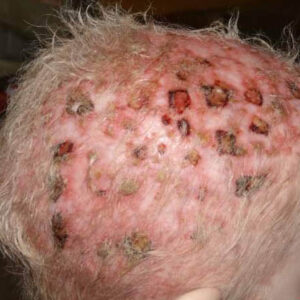
A new strategy to treat AEC skin erosions is giving us hope! Since our 2003 Skin Erosion Workshop, the National Foundation for Ectodermal Dysplasias (NFED) has championed research efforts to find treatment solutions for ankyloblepharon-ectodermal defects-cleft lip and/or palate (AEC) syndrome.

The skin in this particular type of ectodermal dysplasia is fragile and can break down easily. This often leads to painful erosions and infections that can be life-threatening.
A Partner in Progress

Caterina Missero, Ph.D. attended that first research workshop and has been on this journey with the Foundation ever since. She is a Professor of Molecular Biology at the Department of Biology, University of Naples Federico II and the principal investigator at CEINGE, Center of Genetic Engineering. Prof. Missero is an expert in the molecular mechanisms required for gene expression in skin, in health and disease.
She’s participated in all three of our international AEC research conferences. On four occasions, the NFED has proudly funded her research to develop a mouse model for AEC and find potential treatment options.
A Promising New Discovery
We recently asked Prof. Missero for an update of how her lab’s work is progressing. Read below to find out the exciting potential of a new strategy on treating skin fragility in AEC syndrome. It gives us incredible hope for a future free of painful skin erosions.
A New Therapeutic Strategy for AEC Syndrome: Replacing a Damaged Protein to Help Heal the Skin
By Caterina Missero – CEINGE (Center of Genetic Engineering) and Department of Biology, University Federico II, Napoli, Italy
AEC syndrome is a rare genetic disorder that affects the development of the skin, hair, nails, teeth, and other tissues. One of its most serious problems is the presence of fragile, painful skin erosions, especially on the scalp, that are hard to treat and often lead to infections.
AEC is caused by changes (mutations) in a gene called TP63, which plays a key role in forming the skin and other tissues. These mutations damage a specific form of the p63 protein—called p63α—causing it to misfold and clump together inside skin cells, preventing them from working properly.
A New Approach: “Switching” Proteins
In our study, we explored a new treatment idea: instead of trying to fix the damaged p63α protein, we removed the damaged part entirely. This “switch” allowed cells to produce a shorter but still functional form of the protein called p63β, which does not contain the region where the harmful mutations occur.
We tested this approach in two ways: in mice and in human skin cells from AEC patients. In mice, removing the p63α protein did not affect the skin—it looked and worked normally even in old age and after injury. However, other tissues like the palate and limbs still needed p63α to form correctly.
In skin cells from AEC patients, switching to p63β stopped the harmful protein clumps from forming, restored the skin cells’ strength and ability to stick together, and normalized many of the genes involved in skin repair and development.
Shape Our Futures With Research
Ectodermal dysplasia can cause a lifetime of challenges. By supporting research, you expand early diagnostics, treatments, pathways toward cures… and hope!
Donate to ResearchWhat This Means for Families
This research shows that it is possible to help the skin heal by changing which version of p63 is made. While more work is needed before this can be used in patients, our findings open the door to a possible therapy that directly targets the root cause of AEC in the skin. In the future, this strategy could offer hope for improving quality of life for people living with AEC syndrome.
This is fantastic. My son Noah (will be 2 in September) suffers terribly with his scalp, any slight cut or scratch sends his healing back massively. Excited for the updates.