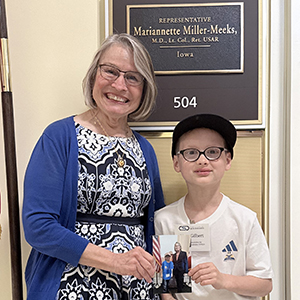
Nine-year-old Liam, has no problem telling legislators about how he’s affected by ectodermal dysplasia, his desire to have dentures, and even his recommendations for the best breakfast!
The young boy from Iowa was in Washington D.C. May 18-19, with his mom, Sara, for the Coalition of Skin Diseases (CSD) Annual Capitol Hill Day. It wasn’t his first time on the Hill.

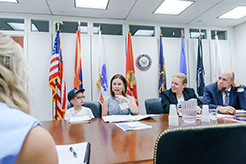
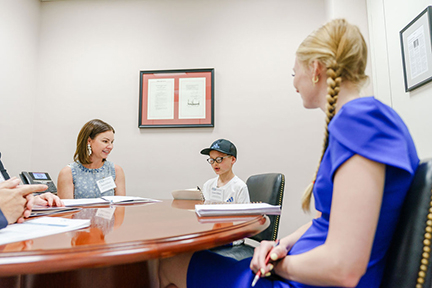
“Going to the Hill, Liam has formed a bond with our U.S. House Representative, Mariannette Miller-Meeks,” Sara said. “It’s heartwarming to see him connect with someone that is fully supportive and can help lead change. She even has a picture of the two of them in her office.”
Advocating for Skin Disease Policy and Research
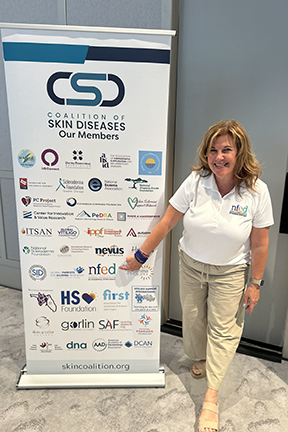
The NFED has been a member of the CSD for several decades. It is the largest consortium of skin disease patient advocacy organizations in the U.S. The CSD is dedicated to advocating for access to quality health care and improved skin disease policy.
Kristin Matus-Kelso, NFED’s Family and Community Programs Coordinator, joined Sara, Liam, and more than 70 skin advocates from peer organizations. They advocated for the Ensuring Lasting Smiles Act (ELSA) and the CSD’s policy agenda which included four other legislative asks. Kristin also has a daughter affected by EEC syndrome.
“Even though we represent different conditions, our families’ stories, like the barriers to insurance coverage and the need for awareness, are very similar,” Kristin said. “We are so much stronger together, and the work that the NFED does for the ectodermal dysplasias community is part of a much bigger movement.”
Advocating for the Ensuring Lasting Smiles Act
If you have been with the NFED for a while, you likely know that ELSA is the bill that the NFED wants the U.S. federal government to pass to guarantee the payment of health insurance benefits for necessary medical care and treatment due to congenital craniofacial anomalies that primarily impact the eyes, ears, teeth, mouth or jaw. Collaborating with other organizations is key to getting it passed.
In May, NFED advocates also participated in the American Association for Dental, Oral, and Craniofacial Research (AADOCR) / the American Dental Education Association (ADEA) / Friends of the National Institute of Dental and Craniofacial Research (NIDCR) Advocacy Day.

This event brought together more than 80 oral health researchers, scientists, dental school faculty and students, and patient advocates. Their aim was to highlight the importance of oral health research and education with policymakers. This included continued federal investment in research at the National Institutes of Health/National Institute of Dental and Craniofacial Research as well as dental education and training programs.
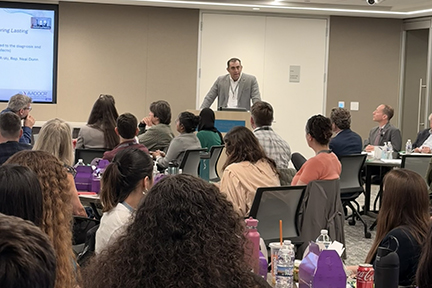
This year, AADOCR/ADEA/FNIDCR identified ELSA as key legislation on their agenda. NFED families from six states joined me to share their stories and attend congressional meetings.
Families Join Dentists and Researchers to Tell The Whole Story
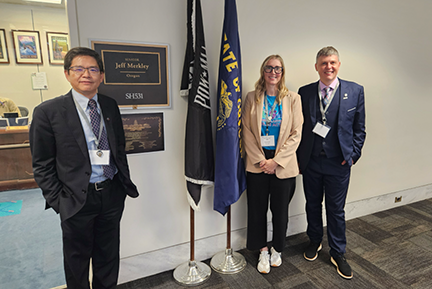
Rebekah has a son who, like Liam, is affected by hypohidrotic ectodermal dysplasia (HED). She has been a committed ELSA advocate for many years and serves as an Advocacy State Lead for Oregon. She said she appreciated the collaboration between AADOCR, ADEA, and FNIDCR.
“This was my first experience participating in meetings that represented the full continuum of care, and it was incredibly meaningful,” Rebekah said. “In every meeting, we were able to show legislators how ELSA affects not only the patient, but the entire care and research community. Sitting alongside oral physician-researchers from across the country, who clearly and directly articulated the real-world impact and the barriers patients face from insurance coverage gaps that ELSA would help close, while I shared the daily realities my child experiences living with a craniofacial anomaly, brought the human impact of this issue into focus in a way statistics alone never could.”
Advocates Appreciated that Legislative Staff Listened
Fellow advocate, New York Advocacy State Lead, and NFED mom, Kerri, said that bringing the ectodermal dysplasias community’s voice to Capitol Hill is about helping lawmakers understand the real-life impact this condition has on children, adults, and families every day.
“One of the most meaningful parts of Advocacy Day was seeing representatives genuinely listen and engage as we shared why the ELSA bill matters beyond the policy language.”
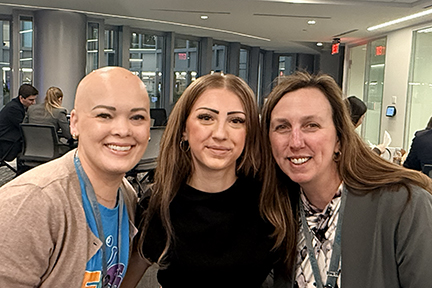
Hannah, who is affected by X-linked HED and a newbie on the Hill, also joined us. She knew this work was so important that she flew to D.C. even though her wedding was the following weekend! She had a clear message for the legislators.
“I wish the lawmakers would know that people affected by ectodermal dysplasias are not able to ‘escape’ or ‘set aside’ the toll it takes on us physically, emotionally, psychologically, socially, and financially.There is no hiding from it and it stays with us in every stage of life.”
The NFED Thanks Organizers and Advocates
Thank you to our advocates, Andie, Hannah, Kerri, Liam, Lucia, Nikki, Rebekah, and Sara for traveling from across the country to share their stories on Capitol Hill. They advocated for ELSA or appropriations that make possible the research that can lead to breakthrough treatments. Each of them represented our community with passion and purpose. I am grateful for them and their stories.
We especially thank the event organizers and our partners at AADOCR/ADEA/FNIDCR and CSD. We are grateful for the invitations and traveling with us as we continue to push for ELSA to become law!
I Invite You to Advocate for Yourself and ELSA
Sharing your story and advocating for yourself can be empowering. Just ask Hannah.
“I was the one who had been hesitant getting involved in a more public way with advocacy in general,” Hannah said. “Growing up and in my younger adult years, I personally felt embarrassed, angry, stressed, and scared to get involved with the public and be able to open up about my condition with others.

“I completed my full upper and lower jaw and teeth restoration about one year ago. Since then, it has given me confidence and the feeling of freedom to talk about it with others. Attending the NFED Family Conference last year, I met other young adults, families and kids who are and have been through similar experiences as myself. It was a good feeling to educate and guide other families who are affected by ectodermal dysplasia.”
I encourage you to take the first step and register as an advocate. If you want to make a bigger impact, become an Advocacy State Lead.
Where ELSA Stands Today
We are still working to garner more co-sponsors for ELSA. Check here to see how many co-sponsors ELSA has in the U.S. Senate and how many in the U.S. House of Representatives. Our goal is to reach a super majority so the bill can come to a vote. Please contact your legislators and ask them to co-sponsor ELSA.
Thanks, everyone, for doing what you can! Continue to reach out to your federal legislators and gain co-sponsors to keep moving this bill forward.
Have a question or comment? Contact us.