
Pamela has had two knees and a hip replaced but it hasn’t stopped her from tap dancing! The 65-year-old grandmother of four has been a dancer and teacher all of her life.
It is also how she’s faced numerous challenges – she just keeps dancing! Pamela encourages others to do the same.
Searching for Answers
Pamela doesn’t know if her joint problems are a part of having incontinentia pigmenti (IP), caused from arthritis or just a result of life as an athlete. But the medical question is nothing new.
For most of her life, she faced numerous medical problems. But, doctors never could explain why she was having them and they didn’t connect them.
“I spent my grade school years wondering why I had bald spots and trying to explain my strange teeth,” Pamela said. “I was always the shortest in my class. Today, I am a towering 4’10” and 96 pounds.”
Vision Loss Changes Her Path
And then came the vision loss in her teens.
“At 15, I fell on my head in a gymnastics accident, causing a detached retina in my left eye. At the time, technology wasn’t what it is now. Any surgical outcome had very poor odds, so my parents left it alone! My eye went blind, I developed glaucoma, and at 18, had an artificial eye.”
Pamela was in college at the time, dreaming of a career in theater and dance. Her small size meant she was often cast in child roles and now she had a fake eye. She said theater was all about how you looked and felt she needed to go in a new direction.
A New Career and a Different Way to Dance
Pamela chose education, becoming a paraprofessional helping teachers in the classroom. And of course, she had a passion for dance so became a dance teacher, too. With vision in only one eye, she had to learn new ways to do what other dancers do.
Pamela said, “Dance is a lot of focus and position where your head is and where you’re looking, and so I had to overcome that, because on the right side, of course, I could do my turns and spot the wall, and on the left side, I had to look way over my shoulder to do it. I had to explain that if I was in class and the teacher’s looking at me going, your position’s wrong, and I’m like, well, I have to overcompensate because…and then they say, okay.”
When her dance students tell her they can’t do things, she uses that story to empower them.
Kids would say, ‘I can’t do this,’ or ‘this is too hard,’ or ‘I can’t do it on my left,’ or whatever. I tell them, ‘I’m blind on this side. You didn’t know that, did you? I had to overcome that, so what did I have to do? I had to look further. So maybe you need to figure out what’ll help you.’ I put a spin on it and made it work in what I did.
Discovering the Cause: Incontinentia Pigmenti
At 40, she began having retinal issues in her right eye. She sought a medical specialist who felt there was more going on and encouraged her to research her medical history. Pamela, who had been adopted at 11 months old, contacted the adoption agency and learned two words that would connect her lifetime of medical issues: incontinentia pigmenti.
Until that point, she had never known.
“My adoptive parents were so happy to finally have a child, that the paperwork describing my condition and the importance of treatment went unnoticed.”
She extensively researched her new diagnosis and realized the retinal issue that caused her to lose her left eye may have been due to IP and not the gymnastic accident. Pamela admits that she was angry that her adoptive parents had not paid more attention to the health information they were given from the agency.
“It’s just overwhelming with all the things I’ve had,” Pamela said, who connects with other IP families on Facebook. “And, at the same time, I’m fascinated the more I hear about it. I like to hear the stories of other people, too, to see what they’re going through, and if anything I have to say could help.”
The Power of Knowledge
When it comes to having IP, Pamela says knowledge and understanding are the most important to her.
“Find out if you have it. Find out everything you can about it so you know what could happen, what you might have, what symptoms you might have that you’re not aware of. The first thing I did when I found out was I jumped on the computer and I Googled it, and I just sat there for hours and read things, because knowledge is key. That could have saved my eyesight if someone had read the paperwork, you know?”
Despite the hardships in her life, Pamela keeps a positive attitude.
“As far as challenges that people are facing, you have to be proactive and positive, because it’s the only way to continue and to be successful and just exist and be happy if it’s who you are. You have to make the best of what you have.”
Finding Love and Support
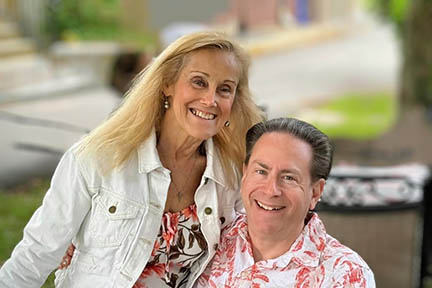
Pamela has a supportive partner in her second husband, Ethan, whom she met at karaoke. When he learned about her vision loss and IP, he went home and extensively researched it. He told her, “The fact that you are who you are and where you are is remarkable,” she said.
“I was like, this guy’s a keeper! For me, it was a turnaround. My whole life was a turnaround. He’s just very wonderful. He helps me with things that I need help with.”
Growing up as an only child with her adoptive parents, Pamela always felt she had brothers and sisters. She applied to the state of New Jersey as an adult adoptee to get her birth certificate. On it, was her birth name and her birth mother’s name. Armed with that information, she researched and found one of her biological sisters.
With the sole intention of learning more about her medical history, she wrote to the sister who responded and the two are now close. That sister helped Pamela understand why their mother put her up for adoption. And Pamela learned she was right, she had four older, biological siblings and two half siblings.
Challenges Growing Up With IP
One of the key signs to diagnose IP are the progressing skin rashes during the first year of life. Pamela suspects that the challenges of caring for her were tough for her birth mother who was going through a divorce from her birth father at the time and raising four older children.
Childhood was often difficult having different teeth and bald patches. Kids were mean and bullied her. Today, she has darker pigmented whorls on her legs and arms that are typical in IP. As a child, she called them her birthmarks when other kids mentioned them.
Her mother found creative ways to tease her hair to cover areas where she didn’t have hair. In the world of dance, where everyone has the same hairstyle, it was sometimes difficult.
“A lot of the scarring I had from the rash was on my head, so I have a lot of spots where there’s no hair. I couldn’t have hairdos the other kids could have. I could never have two ponytails, because if you parted it down the middle, there was a big bald spot right in the middle.”
In college, she dyed her dark hair blonde for a character she was playing in Gypsy and has kept it blond to this day. She feels having lighter hair makes the bald spots less noticeable.
Dancing Into Retirement

Today, Pamela is retired from being a paraprofessional but still teaches dance several times a week. She taught both of her adult daughters and all four of her grandkids. When she’s not dancing at the studio, you may find her dancing in her kitchen, cooking, crafting or making costumes for her grandchildren.
“I’ve had people say to me, ‘how did you survive all this?’ Because my adoptive mom was very strong, it was rough. And then, I had all these things wrong, and I always tried to look for the silver lining somehow.”
She hopes to one day attend an NFED Family Conference, meet others who have IP, and help if she can.
“Besides learning all you can about it, stay positive. Because you have one life, you want to make it the best way you can.”
Have a question or comment? Contact us.
Want to tell us about your experience with ectodermal dysplasia in an upcoming blog?
Share Your Story