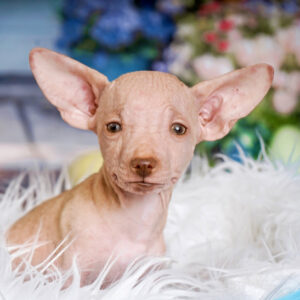
You know that ectodermal dysplasias affect people. But, did you know that the condition can also be found in mice, cows, and even dogs?
Meet Piglet, the Dog with Ectodermal Dysplasia
Meet Piglet. She’s a 3-pound dog with tricho-dento-ossous (TDO) syndrome, a rare type of ectodermal dysplasia.
Piglet was born last January. She was the runt of her litter and the only puppy to have TDO, said Ruth Patrick, who was fostering Piglet’s mother when the puppies arrived.
A Rough Start to Life

At first, Piglet didn’t move like her brothers and sisters. And she definitely looked different. She had no hair and a crooked tail. Ruth wondered if she had been born too early. Then, Piglet made a tiny squeak and started wiggling. Ruth snapped a photo and sent it to the rescue group she worked with. A vet looked at the picture and said Piglet’s fully formed claws meant she was not premature.

Ruth and the vet still didn’t know if Piglet would survive. Ruth fed her with a syringe for weeks to keep her alive. After a while, she was strong enough to latch onto her mom. Ruth thought Piglet might simply be a hairless Chihuahua.
Discovering More Health Challenges

After a month, Ruth noticed Piglet had trouble walking with her back legs. X-rays showed floating kneecaps on her back legs, an extra lumbar vertebra and a missing thoracic vertebra that made her spine curve.
Local vets suggested that Ruth contact the veterinary school at UC Davis School of Veterinary Medicine which would have specialists to address Piglet’s many symptoms. But, she knew it would be difficult to get an appointment at the highly sought after clinic.
Then, help came from an unexpected place.
Help From Social Media for Dog with Ectodermal Dysplasia
A UC Davis alum stepped in to help. Ruth had been sharing Piglet’s photos on Instagram since the day she was born, hoping someone might recognize her symptoms. Piglet soon became a social media favorite. A veterinarian trained at UC Davis saw one of Ruth’s posts and helped Ruth get an appointment.
At UC Davis, doctors quickly diagnosed Piglet with ectodermal dysplasia and ordered genetic testing. When Ruth searched online, she found other dogs with x-linked hypohidrotic ectodermal dysplasia (XLHED). But, Piglet didn’t look like those dogs. Soon, she learned why.
A Rare Diagnosis: TDO Syndrome
Testing showed that Piglet has a change in the DLX3 gene which causes TDO syndrome. Doctors could not find any other dogs in the medical literature with this exact condition. It’s likely other dogs have it but they have not been documented.
Life Today: Fragile but Full of Energy

With so many issues, Ruth wasn’t sure how long Piglet would live. Now, at 11 months old, Piglet’s active, loves to chase a ball or toy, and is doing well. But she still needs special care.
Piglet’s skin is very dry and sensitive. Ruth puts lotion and a natural sunscreen on her. Piglet gets medicated shampoo baths twice a week. Because she is small and hairless, Piglet gets cold easily. She wears clothes and uses a heating pad or blanket to stay warm, even in summer. Piglet has no teeth but Ruth says she eats just fine. She’s a bit fragile at times. When she plays too much, she sometimes starts to limp.
“You see her in person, and you wouldn’t even hardly know she has a condition,” Ruth said. “I mean, obviously, you can tell that she’s hairless and toothless, but she plays with all my other dogs, and she eats food just fine. A ball goes flying by, and she’s rushing across the room. You see that she’s just like any other dog, and gets around just fine. She’s very spoiled.”
A Media Star
Piglet has captured hearts online and in the local news. Ruth entered Piglet’s picture into a contest at the Butte Humane Society. People could vote on their favorite dogs and the winners would be featured in their 2026 calendar. Piglet won first place and now graces the cover!
She often rides in a mesh backpack and people sometimes stop to ask what she is, unsure of if she’s very old or if she’s even a dog. That curiosity gives Ruth an easy way to share Piglet’s story and raise awareness of TDO syndrome and ectodermal dysplasias. You can follow Piglet’s story on Ruth’s Instagram or watch the Instagram Live we did with Ruth and Piglet.
How Other Dogs Helped Advance Treatment for Humans

You may remember that a colony of dogs in the 2000s advanced research for XLHED. Those dogs had patches of sparse hair and missing teeth. The NFED supported Dr. Magi Casal’s research at the University of Pennsylvania where she treated affected puppies before birth with ER004, the missing protein in XLHED. The treatment improved their symptoms and helped pave the way for the XLHED clinical trials in humans.
TDO Syndrome in Humans
TDO syndrome in humans is one of the more rare types of ectodermal dysplasias. The NFED is connected with 71 people who have the condition. It typically affects the hair (tricho), teeth (dento), and bone (osseous).
For Ruth, she’s found it interesting to learn about this syndrome and how it affects humans, too. She hopes that by sharing Piglet’s journey, she can help raise awareness about the condition in both animals and humans.
Share Your Story
Have a question or comment? Contact us.
Featured image at the top of the page is courtesy of Greenfield Pet Photography.