
This blog is the second in a two-part series about how to prepare if your newborn child is affected by Goltz syndrome. Read the first blog.
If you are expecting a child or have a newborn affected by Goltz syndrome, the National Foundation for Ectodermal Dysplasias has published a comprehensive resource to help you know what to expect. It’s written by the medical experts on our Scientific Advisory Council.
Goltz syndrome is complex and no two people are affected exactly alike. But sharing personal stories can be helpful as you learn more about the condition from other experts: the parents of those affected.
Get ready to meet Eliza, Finley and Emmeline.
Eliza’s Story: Meeting All Her Milestones
By April, mother of Eliza from Minnesota

Our first clue that Eliza may have a genetic syndrome was when she was still in the womb. Her 20-month ultrasound revealed significant heart anomalies. Congenital heart anomalies are often affiliated with genetic syndromes. Before she was even born, the hospital system that we are affiliated with had Eliza scheduled for genetic counselling. This was scheduled for a few weeks after Eliza’s due date.

As soon as Eliza was born, signs of a genetic syndrome were apparent. Eliza was born with patches of skin missing. She was actively bleeding from several sites. In other areas, the skin seemed abnormal in texture or thickness. There seemed to be a stripe down her face, slightly to the left of midline. Eliza also had some webbed fingers and her left eye did not seem to open as much as the right.

We are thankfully near a university hospital with a wonderful genetics department. At about a month old, our geneticist diagnosed Eliza with Goltz syndrome, which was later confirmed by genetic testing. Our geneticist made sure to write referrals for all the necessary specialists, so Eliza has had fantastic care since infancy. It was quickly identified that Eliza has a chorioretinal coloboma and blocked tear duct of the left eye. She had surgery to open the tear duct and now her eye opens and appears normal.
She had hearing loss due to chronic middle ear fluid, which was promptly remedied with a set of ear tubes. And she had her fingers separated before her first birthday, so she should have completely normal use of her hand without any additional therapy.
Eliza will need surgery to repair her heart and an umbilical hernia. She will probably always have to wear a heel lift on the left side to compensate for a leg length difference. And her teeth are abnormal in shape and spacing, so we plan to spend a lot of time with dental professionals in the future.
Other than that, she is a perfectly normal, healthy girl. She is super smart and sassy. She knows how to get her way, which usually involves being absolutely adorable. Despite her challenges, she is meeting or exceeding all developmental milestones. I expect great things from this sweet, little lady!
Finley’s Story: A Fighter from the Start
By Lauren, mother of Finley from Alabama
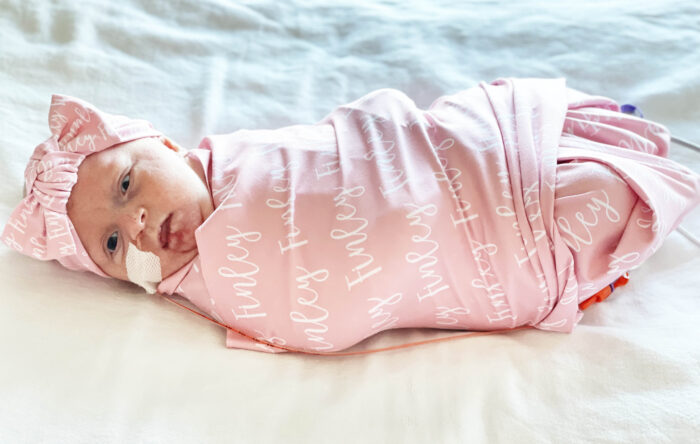
Finley was born in 2023. While pregnant, there were no indications that she would have any genetic anomalies or other medical findings that would suggest a Goltz syndrome diagnosis. At one week old in the neonatal intensive care unit (NICU) at Children’s of Alabama, a team of geneticists came in and examined her from head to toe. After sending off their findings, they came and spoke with us about what they thought was going on. Their first thought was correct, our sweet girl has Goltz syndrome.
She was born with an abdominal omphalocele which led to a chest wall and sternal reconstruction. This allowed the doctors to move her heart to a more anatomically correct position. She has had a G-Tube place, which was replaced by a G-J Tube shortly after. She is blind in her left eye, and her retina and optic nerve are damaged and have malformations in her right eye.
She is hard of hearing in both ears. Her skin integrity is compromised and keeping her from overheating is a battle at times. Her sweet little toes are fused and we are scheduled to have two of her toes and part of one foot amputated next month.

The hard diagnosis to come to terms with for us is that Finley’s cognitively impaired, and will likely be unable to navigate life the way we had hoped for her to be able to. Finley has fought hard most of her life, but her battles have made her the strongest girl we know. She is the happiest baby in the room. She keeps us laughing and on our toes. Our world is so beautiful with her in it!
Emmeline’s Story: Diagnosed Before Birth
By Anna, mother of Emmeline in the United Kingdom

We learned that Emmeline had Goltz syndrome at 25 weeks of pregnancy.
Emmeline was diagnosed at 25 weeks pregnant due to differences in her feet, small size, kidney and heart issues which then triggered genetic tests. She has ventricular septal anomalies (VSDs), a notch in her iris, mild skin issues (the worst on her chin), three small teeth and one missing.
She was tube fed but no longer is. She eats food. She has been in the second percentile all her life for growth. In the photo at five months old, her hair is still a little patchy on one side and she has one hidden bald spot at the back.
Stay Tuned for the Next Blog
We have one more blog in this series on the first year of life with Goltz syndrome. Read blog three to learn more about newborn boys affected by the condition.
Have a question or comment? Contact us.