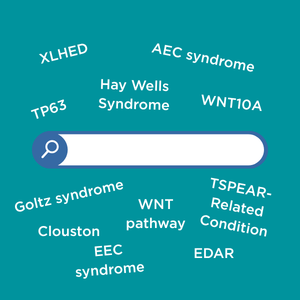
We all agree that the conditions are called ectodermal dysplasias. But, what do you call your specific type, if you know it?
With genetic advancements happening rapidly, what is and what is not classified as an ectodermal dysplasia is evolving. To make things even more confusing is that different people might call your type of ectodermal dysplasia by different names. Let’s look at the three ways people call a syndrome, when to use each name, and why.
Calling Your Ectodermal Dysplasia by its Syndrome Name
For a long time, syndromes were often named after the researcher(s) who first identified it. For example, Goltz syndrome is named after Dr. Robert Goltz. In more recent years, genetic conditions often go by a clinical name that is more descriptive of the symptoms of that syndrome. In the case of Goltz syndrome, it is also known as focal dermal hypoplasia (FDH). Both names are accurate. Therefore, make sure you always know any synonyms for your type as you talk to professionals or read educational resources. Also, be aware of the different names of your syndrome so you are not confused if a provider calls it by an alternative name.
It’s best to use the name for your syndrome when you talk to your doctors or dentists, or school personnel. This provides a quick, standardized snapshot of your overall health picture, typical prognosis, and standard management guidelines.
Understand that the name of your syndrome may change over time.
Calling Your Ectodermal Dysplasia by Its Gene
Increasingly, the genetics community classifies and calls syndromes by the gene that is involved rather than the syndrome name (such as TP63-related disorders). Scientists have identified the causative genes for each of the 50 types of ectodermal dysplasias. Sometimes there can be multiple, different genes that can cause the same syndrome, as is the case with hypohidrotic ectodermal dysplasia (HED), which can be caused by changes in the EDA, EDAR, EDARADD, and WNT10A genes. Other times, there may be one gene that can cause different syndromes, as is the case with the TP63 gene.

In the 1980s, the NFED used to refer to Hay-Wells syndrome and Rapp-Hodgkin syndromes as two distinct types of ectodermal dysplasias. Through research, we learned they are actually the same syndrome which now is called ankyloblepharon-ectodermal defects-cleft lip and/or palate (AEC) syndrome and is caused by a change in the TP63 gene. Then, it was discovered that the TP63 gene also causes three other types of ectodermal dysplasia: acro-dermato-ungual-lacrimal-tooth (ADULT) syndrome, ectodactyly-ectodermal dysplasia-chelfting (EEC) syndrome, and limb-mammary syndrome. Those are different syndromes, but we often refer to them as TP63 conditions as they can share characteristics and research being done on the specific gene may have applications to each syndrome.
Genetic Testing Determines What Type of Ectodermal Dysplasia You Have
Genetic testing is the only way to determine if you have a genetic change that causes ectodermal dysplasia. Your report will identify the gene that has been found to have the change that resulted in your type of ectodermal dysplasia. Your genetics counselor or doctor who explains the results to you may call it by this gene name or by its clinical name.
We encourage all families to explore genetic testing. There are many benefits of a specific diagnosis. It can confirm your diagnosis and help you access potential treatments. For instance, the treatment being studied in the Edelife Clinical Trial is only for individuals with a change in the EDA gene that causes XLHED, not any of the other genes for HED. Given that treatment timing for that trial is critical, knowing the gene is equally important. In addition, knowing your specific gene will help if you are searching on academic databases, such as ClinVar or PubMed, to learn more about your syndrome.
While the name of your syndrome can change over time, the gene that caused it will not. It will remain the same.
Calling Your Ectodermal Dysplasia By Its Pathway
According to LibreTexts, “Genes do not function in isolation but rather suites of genes act in concert to perform biological functions. When different genes function in different sequential steps of a biological process, this is known as a genetic pathway.”
In our ectodermal dysplasias classification, the conditions are grouped according to five different pathways: EDA-NFKB pathway, WNT pathway, TP63 pathway, structure group and others.
Problems in the same pathway can cause many different types of clinical conditions. A good example of this is the WNT pathway. Researchers have identified 10 different types of ectodermal dysplasia in this pathway. Many families have reported being told by genetics providers they have a WNT-related condition, instead of being given a specific syndrome name. While this may have advantages for researchers and health care providers as it can provide broader context to understand how the variability of the conditions and how they are all related, families often prefer to know how they will specifically be impacted.
If a researcher develops a treatment that fixes a specific biological pathway, it might treat multiple, differently named conditions within that same pathway. If you are researching clinical trials, it might be useful to know what pathway your syndrome is in.
A Practical Approach
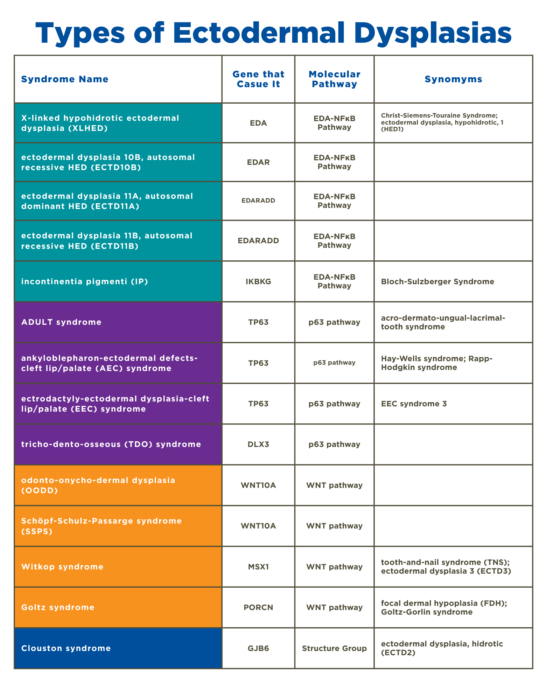
So, what should you call your syndrome? When learning about your type of ectodermal dysplasia or explaining it to care providers, you could combine them, if you know all of the information.
For instance: “I am affected by [Condition Name], which is caused by a change in the [Gene] gene. This gene affects the [Pathway] pathway in my cells.”
Example: “I am affected by Goltz syndrome, which is caused by a change in the PORCN gene. This gene affects the WNT pathway in my cells. Goltz syndrome is also called focal dermal hypoplasia or Goltz-Gorlin syndrome.”
For some syndromes, this can still be tricky. We call the most common type of ectodermal dysplasia, hypohidrotic ectodermal dysplasia (HED). But it used to be referred to as Christ-Siemens-Touraine syndrome. And most recently, each type of HED caused by a different gene has its own name!
For example, x-linked hypohidrotic ectodermal dysplasia (XLHED) used to be known as Christ-Siemens-Touraine syndrome, is now known also as ectodermal dysplasia 1, hypohidrotic, is caused by the EDA gene, and is found on the EDA pathway. Confused? Easy to understand why.
For many of you, you may not yet know what type of ectodermal dysplasia you have so you have what we call ectodermal dysplasia, type unknown. Genetic testing may have not provided an answer – yet. If it’s been some time since you have had genetic testing, consider repeating it since testing keeps advancing and more genes are found all the time. You can apply to our Treatment Assistance Program for a stipend to help pay for genetic testing.
We’re Here to Help You Know Your Ectodermal Dysplasia
One thing is certain. How we refer to types of ectodermal dysplasias will evolve. Our job is to help you stay informed and understand the changes when they happen. If you have any questions, reach out to Kelley at kelley@nfed.org.
Have a question or comment? Contact us.