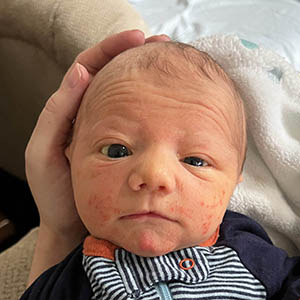
This blog is the final story in a three-part series that talks about what life is like in the first year of life for a baby affected by Goltz syndrome, also called focal dermal hypoplasia. If you haven’t already, be sure to read the first and second blogs in this series. They share stories about baby girls affected by Goltz syndrome and what they experienced. In this last part, we shine a light on some very rare stories: those of boys!
A Very Rare Condition
Did you know that Goltz syndrome is one of the more rare types of ectodermal dysplasia? An NFED prevalence research study found that 0.10 people out of every 100,000 people are affected. What’s even rarer is for a boy to have Goltz syndrome. Only about 10% of all people with the condition are boys. Out of 228 people with Goltz syndrome in the NFED’s database, only 28 of them are boys.
Boys Are Even Rarer
Goltz syndrome happens because of a change in a gene called PORCN. The condition is inherited as an X-linked dominant disorder. Most of the time, it’s considered “lethal” for a male pregnancy. The boys who do have Goltz are considered mosaic. That means some of their cells have the gene change and some do not. Because of this, boys are often affected more mildly than girls.
Helping Parents Through the First Year
Since Goltz syndrome is so uncommon, the NFED has created a new resource to help parents who are expecting a baby or who have recently welcomed one with Goltz syndrome. This guide helps families understand what to expect and how to navigate the first year of life.
Download Goltz Newborn GuideMaximus and Asher are two of the 28 males in touch with the NFED. While they are no longer newborns, their moms shared with us what their lives have been like.
Maximus’ Story: Beating the Odds
By Brandie, mother of Maximus in Utah

Our miracle baby boy was born to us in 2011. He shocked us all when we learned he should not have survived the womb due to a condition he was born with called Goltz syndrome. It is so rare and only a handful of those are boys.
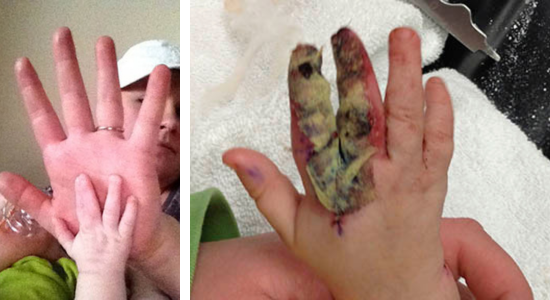
The things he was born with consist of the following: webbed pointer and middle finger on right hand.
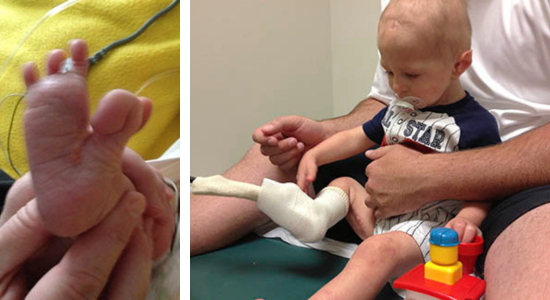
He’s missing a toe and has a deformity in his big toe (it curls under his foot).

He has colobomas in his eyes and a skin condition that will require life long treatment and care.

We won’t know for sure but he may need major dental work because Goltz tends to affect the gums and mouth. Most of our doctors don’t know much about Goltz because it is so rare and has never been seen by most of the doctors we see. So it is a learning curve for all!

Maximus has had over 25 surgeries for various things in his short 13 years of life! And we know there will be more. He is now a typical teenager and is thriving! He really does deal with his condition well and doesn’t let it get him down or stop him from doing much. Maximus loves to cook and is really good at it. He is really into YouTube and wants his own channel. He also loves video games.

Maximus has one brother and two sisters and they are all very close. We live in Utah and love camping, traveling, swimming, paddle boarding, being with family and so much more. Maximus is a fighter and he is so loved by all who meet him!
Asher’s Story: Skin and Eye Challenges
By Crystal, Asher’s mom in Oklahoma

Asher is now three years old, but these pictures are from his first year of life. His skin has good days and bad days. It appears darker red when he is warm, sick, or upset. Sometimes his skin is rough and other times it’s smooth.

I’ve included pictures of his skin, his polydactyly and syndactyly, as well as his eyes that show how he looked a lot of the time when his tear ducts were blocked.


Would you like to connect with other families affected by Goltz syndrome? Join our private Facebook group.
Join Private Goltz Facebook GroupHave a question or comment? Contact us.