Dear NFED,
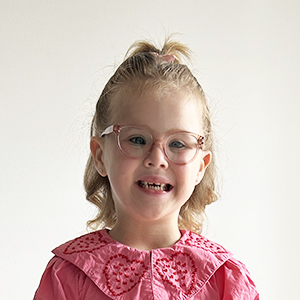
My name is Anya, and I’m the mum of a wonderful six-year-old little girl called Mia-Rose, who was diagnosed with TSPEAR-related ectodermal dysplasia in 2023.
Our journey began back in 2020 when Mia-Rose was around six months old. Her first teeth started to erupt, exactly when you would expect a baby to begin teething. Her bottom front teeth were the very first to come through, but the moment they cut through I knew something wasn’t quite right. They were pointy and cone-shaped. I’d never seen anything like it before. Although I didn’t know what it meant, I knew they didn’t look like typical baby teeth.

From that day, I started searching for answers.
Searching for a Diagnosis
At that point, I had no idea what ectodermal dysplasia even was. I was simply Googling things like “pointy baby teeth”, trying to understand why my baby’s teeth looked so different. That’s actually how I first found the National Foundation for Ectodermal Dysplasias (NFED) in 2020. Your website introduced me to ectodermal dysplasia and gave me my first real clue that there could be an underlying condition. I signed up to your newsletters because I was desperate to learn everything I could.
At the time, though, almost everything I found about ectodermal dysplasia seemed much more severe than what Mia-Rose was experiencing. Although there were similarities, there were also huge differences. After a while I stopped following as closely because I felt like nothing truly reflected my daughter.
Trusting My Instincts Led to A Diagnosis
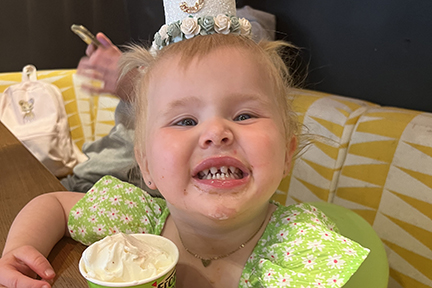
As Mia-Rose grew, I continued to feel there was an underlying reason for the way her teeth were developing. I had to keep advocating for her and pushing for a referral because I knew something wasn’t quite right. Looking back now, I’m so grateful I trusted my instincts, because that eventually led to genetic testing and her diagnosis of TSPEAR-related ectodermal dysplasia in 2023.
Something I’ve only realized very recently is that, although TSPEAR was written throughout her genetics report, I never really understood how important that word was. I knew Mia-Rose had ectodermal dysplasia, but I thought TSPEAR was simply the name of the gene where they had found the change. I never realized that searching specifically for TSPEAR would lead me to information that was much more relevant to my daughter.
Resuming the Search for Information on TSPEAR
The reason I started searching again this past summer is because Mia-Rose had reached a brand-new milestone—her very first wobbly tooth.
She was so excited, and so was I. Watching her grow up is incredibly special. But, if I’m honest, it also brought back so many of the questions I had when she was little.
As excited as I was for her, there was still that little worry in the back of my mind about what would happen once that tiny tooth finally fell out. Would her permanent tooth be there? What would it look like? Would it be cone-shaped like her baby teeth? I knew nobody could answer those questions until the time came. But, naturally they led me back to searching for information again.
This time, I searched specifically for TSPEAR. Everything suddenly clicked. Reading that there are only a small number of reported families made me realize why I’d struggled for so many years to find children whose experiences truly reflected Mia-Rose’s. Then I started reading the family stories, and I honestly found myself smiling and nodding along, thinking, “Oh my goodness… that’s Mia-Rose!”
For the first time in years, I felt like I wasn’t trying to compare my daughter to children with completely different forms of ectodermal dysplasia. I was reading about children whose journeys genuinely resembled hers, and it made me feel so much less alone.
How TSPEAR-related Ectodermal Dysplasia Affects Mia-Rose
Mia-Rose’s condition has mainly affected her teeth and her hair.
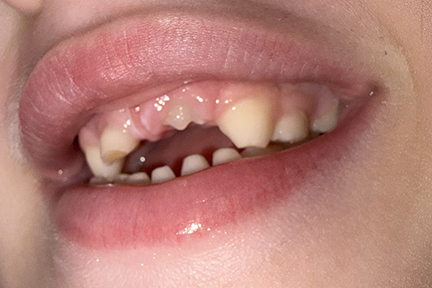
Her front teeth erupted cone-shaped and have gradually worn flatter over time through normal use. She’s missing her upper lateral baby incisors, but all of her other baby teeth are present. Her molars have always looked completely typical, and she’s now had her first permanent molars erupt, which also look completely typical.
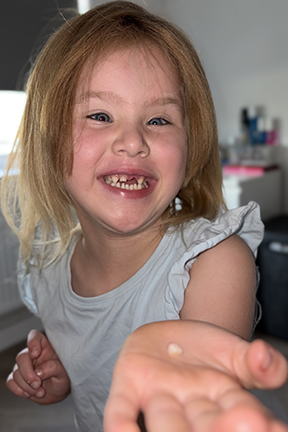
Mia-Rose did lose that very first wobbly tooth on August 9, and her adult tooth has now started coming through. Thankfully, her adult tooth has started coming through and, so far, it appears to be coming through as you would typically expect. Seeing that has been incredibly reassuring for me and has given me so much hope for the future. Of course, we still don’t know what all of her permanent teeth will be like, but seeing her first adult tooth beginning to come through has been such an exciting milestone for us.
She Dreams of Rumi Hair
Her hair was incredibly sparse when she was younger, and one of my biggest worries was whether she’d have enough hair by the time she started school. Thankfully, over the years it has thickened so much. It’s still quite fragile, very straight and doesn’t grow particularly long, but it’s healthy, and she now loves having French plaits, bubble braids, and ponytails. She asks me almost every day if her hair is long enough for “Rumi’s hair,” from K-pop Demon Hunters, which always makes me smile!
Mia-Rose also sweats as you would typically expect, which has always been reassuring for us. She does have quite dry skin, although she doesn’t have eczema. Overall, we’re incredibly grateful that her condition has mainly affected her teeth and hair and that she’s such a happy, confident and sassy little girl.
Having TSPEAR Information Calmed My Fears
Finding your TSPEAR information has genuinely changed how I feel about the future. Instead of feeling frightened about what’s to come, I’m feeling hopeful. I finally feel like I’ve found families whose children truly resemble Mia-Rose, and for the first time since our journey began, I don’t feel quite so alone.
It also makes me so happy to see TSPEAR-related ectodermal dysplasia becoming more recognized, researched and spoken about. When Mia-Rose was a baby, I couldn’t find stories that reflected her experience. Now, seeing TSPEAR being acknowledged and families sharing their journeys gives me so much hope—not only for Mia-Rose, but for every parent who begins this journey after us.
If our journey could help even one family who is sitting where I was back in 2020—looking at their baby’s tiny pointy teeth, feeling frightened and searching endlessly for answers—then it would mean the world to us.
Thank you for everything you do for families living with ectodermal dysplasias, and thank you for helping families like mine feel seen, understood and a little less alone.
Anya is a guest blogger for the NFED. She lives in the United Kingdom with her daughter, Mia-Rose.
Resources
- Discover a Newer Syndrome: TSPEAR-Related Ectodermal Dysplasia
- What Do I Call My Type of Ectodermal Dysplasia?
- A Smile Shouldn’t Require a Miracle: Why We Need Insurance Reform for Genetic Dental Conditions
Have a question or comment? Contact us.