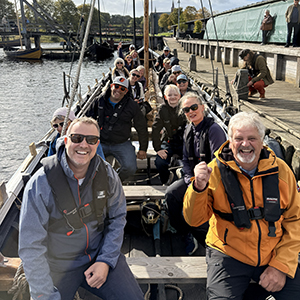
“It’s not so much that we need to see ourselves as connected,” the first mate of our Viking ship shared with me over lunch. “Rather, we need to become increasingly aware that we are not separate.”
The nuance is subtle, but it is so very real. I felt it from the moment I arrived in Copenhagen, Denmark for this year’s Ectodermal Dysplasias International Network (EDIN) leaders’ meeting.
As I looked around and saw organizational representatives from 15 different nations gathered in the Radisson Hotel lobby, many who were affected by a type of ectodermal dysplasia, I knew I was among family despite never having previously met. We were woven together by genetics, whether our own or a love for people whose anomalies have the same family surname-ectodermal dysplasia.
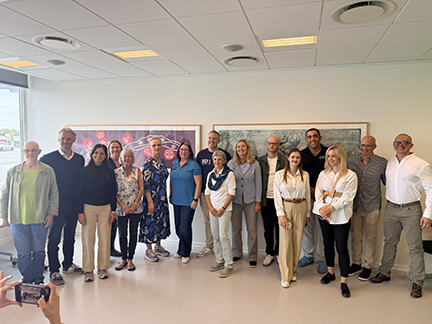
Stories that Sound Like Home
Similar to the National Foundation for Ectodermal Dysplasias (NFED) Family Conferences, I spent most of my time listening to the stories of individuals who are affected, parents, and care providers. Their stories are so familiar.
I listened to Iva, a dentist from Croatia, who was there not so much for professional purposes, but because her first patient with ectodermal dysplasia was her three-year-old son. I shared lunch with Ingrid, a woman with ankyloblepharon-ectodermal defects-cleft lip and/or palate (AEC) syndrome who is supporting efforts in the Netherlands. She shared with me that she has never met someone else with her condition. She wants to learn from the NFED about how to mobilize online storytelling to help make connections in her country. I shared with her about how encouraged we are by our research efforts related to P63-related syndromes.
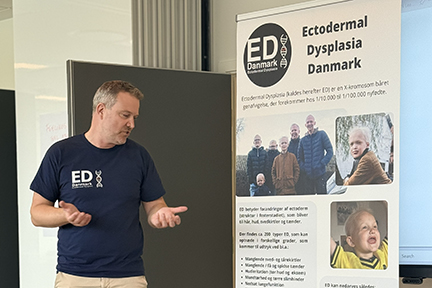
Anders, a Danish man affected by X-linked hypohidrotic ectodermal dysplasia (XLHED) and with 97% vision loss, took us on a tour of Handicaporganisationernes Hus, the world’s most accessible office complex and hub for organizations committed to accessibility. He reminded us of the importance of advocacy efforts that push for all our community spaces and resources to be designed so all can engage and thrive.
From “Something is Wrong” to “Something to Manage”
I was moved to tears when Matías, a dentist from Chile who was affected by XLHED, talked about his own journey and the challenges he faced with his dental care, inability to sweat, and other obstacles posed by his type of ectodermal dysplasia. Through the courage and care of his parents, especially his late mother, Matías shared through tears, “I needed to move from thinking ‘there is something wrong with me’ to ‘there is something I need to learn how to manage.’”
And manage he has. In addition to his devotion to physical fitness, Matías has also become a well-respected educator in oral healthcare with a significant social media presence in his home country. He reminded the room, “I needed to stop pulling against my body and instead listen to it.”
Matías now has founded the first ectodermal dysplasia organization in Chile.
I could go on.
A Global Network for Leaders and Friends
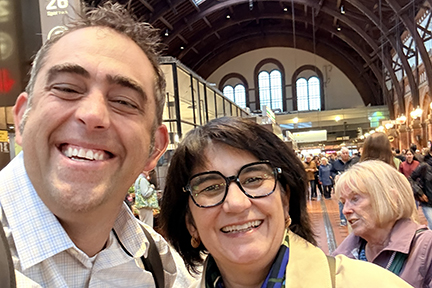
Cécile Fournier from Pierre Fabre traveled from France to present on the Edelife Clinical Trial we have helped to drive. We have spent many hours together on ZOOM calls. It was so good to finally meet in person. I also met Mariana (pictured below), who is affected by HED. After growing up at NFED Family Conferences and being mentored by the late NFED founder, Mary Kaye Richter, she now leads the Mexico organization.

Beth, affected by ectrodactyly-ectodermal dysplasia-clefting (EEC) syndrome and from ozED in Australia, has deep ties to our NFED family and now serves as a digital communicator for EDIN. And of course there were our friends from the ED Society in the United Kingdom (see below), especially founder Diana Perry, who is working with us on various research studies and educational resources like the Women’s Health Study, which will launch soon.

Each person I met was a reminder that there is a power in being seen and known, hope in being heard, and a rare resilience found in discovering that none of us are truly separate.
A Lesson from a Viking Ship
On the last day of the gathering, leadership of the host Danish organization took us on a Viking ship tour. I was on a bench, oar in hand, next to Erik, a curious, witty, and kind teenager affected by XLHED. We were not very good at first! Outfitted with life preservers and zero previous knowledge of how to sail the seas, we boarded the boat as a group unsure how we were going to get ourselves out of the harbor. Our captain kept telling us, “ro i takt,” translated from Danish as row in rhythm.
Watch the one or two rowers in front of us (not the whole boat), match their strokes, and pay attention to the wind. Whether you sat up front, in the back, or somewhere in the middle, your ro mattered. Eventually, we started to move in sync and raised the sail. We trusted one another, adapted to the conditions, and laughed as a community committed to a shared venture we didn’t know was initially possible. Erik even controlled the rudder, with a look of pride and confidence I will not soon forget.
45 Years of Building the Ectodermal Dysplasias International Community
Over train rides, long dinners, and yes, a pint or two, we talked a lot in Copenhagen about how the NFED has been a vital part of building this EDIN boat since 2007. After all, the NFED has been at this work for 45 years and counting, the longest of any organization around the world. This history is less a badge of honor and more a responsibility we need to steward well.
We also need reminders now more than ever that we are not alone in this work. We have siblings from around the world whose stories and discoveries deeply matter. They are in front, behind, and next to us, oars rowing in the same waters we navigate, albeit stateside. We need each other. We need to pay attention to and collaborate with one another. Like Erik, we need curiosity as much as contribution. When we hold space for both, we will be able to move out of harbors and into futures that are brighter for us all.
We Are Far From Separate
Yes, there are variances in language and national origins, generations, syndromes, and so much more, but we are far from separate. This is the real value and beauty of EDIN and our regular gatherings. And it is why we at the NFED are proud to be a part of this network as a founding member.
I am grateful I could represent our community in Copenhagen!
Kærlig hilsen (sincerely),
Greg Klimovitz