
Talking about genetic conditions in families can be hard. Some families, like Peter and Beth’s below, may be able to trace x-linked hypohidrotic ectodermal dysplasia (XLHED) back to the 1850s. Others may be learning about it for the first time.
Either way, if you are a man affected by XLHED, your female relatives might not realize they could be carriers. The Edelife Clinical Trial is a great reason to start the conversation. By sharing what you know, you could help a baby in your family and families around the world.
Researchers are studying the first potential treatment for XLHED in the trial. If eligible, you and your loved one may be able to participate. But it’s important for you to know that timing is critical.
Why This Matters
Researchers have developed ER004, a protein that mimics the one missing in individuals affected by XLHED. By giving ER004 to an affected baby boy before birth, during the right time of development, it might help trigger the normal development of a baby’s skin, teeth, hair, and sweat glands.
In a past study, six boys received ER004 before they were born and are now sweating completely normal and have other improved symptoms! This gives researchers and the NFED hope that ER004 could change the future for families affected by XLHED.
But, there’s one challenge. Many women do not know they carry the changed gene for XLHED until after giving birth to an affected baby boy. By then, it’s too late to join the trial because the investigative treatment must be given during pregnancy.
That’s where you come in.

If you are an affected man, please share this information with your female relatives, like your daughters, nieces, aunts, or sisters. They may carry the gene that causes XLHED and qualify for the trial.
This is especially important if they are pregnant or planning to be. Participating in a clinical trial is a personal decision and may not be for everyone. But to make an informed decision, a woman first has to know if she carries the changed gene.
Understanding the Genetics
Men and women affected by XLHED can often show symptoms very differently. Here’s why. XLHED is caused by a change in the EDA gene and can be passed from parent to child. The gene is located on the X chromosome.
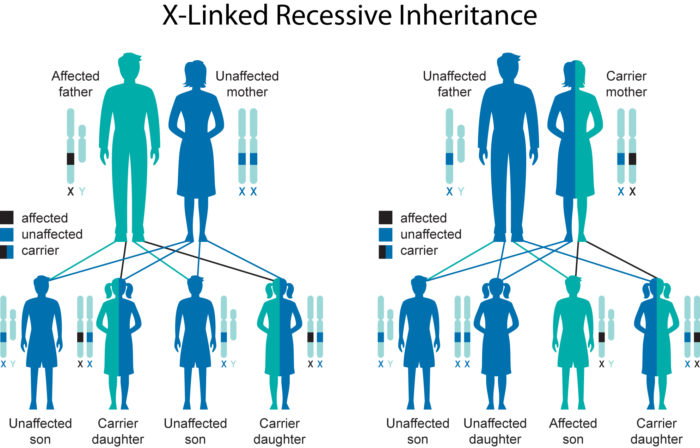
- Men have one X and one Y chromosome. If their X chromosome has the changed EDA gene, they show all the typical signs of XLHED.
- Women have two X chromosomes. One of the X chromosomes has the changed EDA gene and the other X chromosome has a “normal” copy of the EDA gene. Therefore, the woman may have no symptoms, mild symptoms, or be more affected. There’s no way to predict how much they might be affected.
You can see from the diagram that if you are a man who has XLHED, all of your daughters will carry the gene. The only sure way to know if a woman carries the gene is through genetic testing. The NFED offers stipends to help with testing costs.
How Men With XLHED Can Participate in the Trial
If you are an XLHED-affected man, and a woman in your family joins the trial, you may be able to participate, too. As a blood relative, you would visit the study site one time. You would not receive the treatment. Researchers would collect data from you to compare with your treated family member. This helps them understand if the treatment worked.
Learn More
Researchers are looking for 20 families to join Edelife. Thirteen are already enrolled and more are needed. Here’s how you can learn more:
- Visit our Edelife page to learn more and explore resources, like the most recent webinar including conversations with doctors and a participating family.
- Visit the official trial website.
- Contact me directly at mary@nfed.org or 618-566-2020. I’d be happy to answer questions and guide you through the process.
Our hope is that one day, this treatment will be available to all families affected by XLHED. Until then, we invite you to begin the conversation in your own family today!
Have a question or comment? Contact us.